


Hits:Date:December 17, 2025
Recently, the results of the 11th National College Physics Experiment Competition (Innovation) final were announced. Three teams from our university advanced to the finals and all won first prizes at the national level, ranking among the top universities nationwide in both the number and quality of awards. This achievement marks the best performance in the history of our university in this competition.
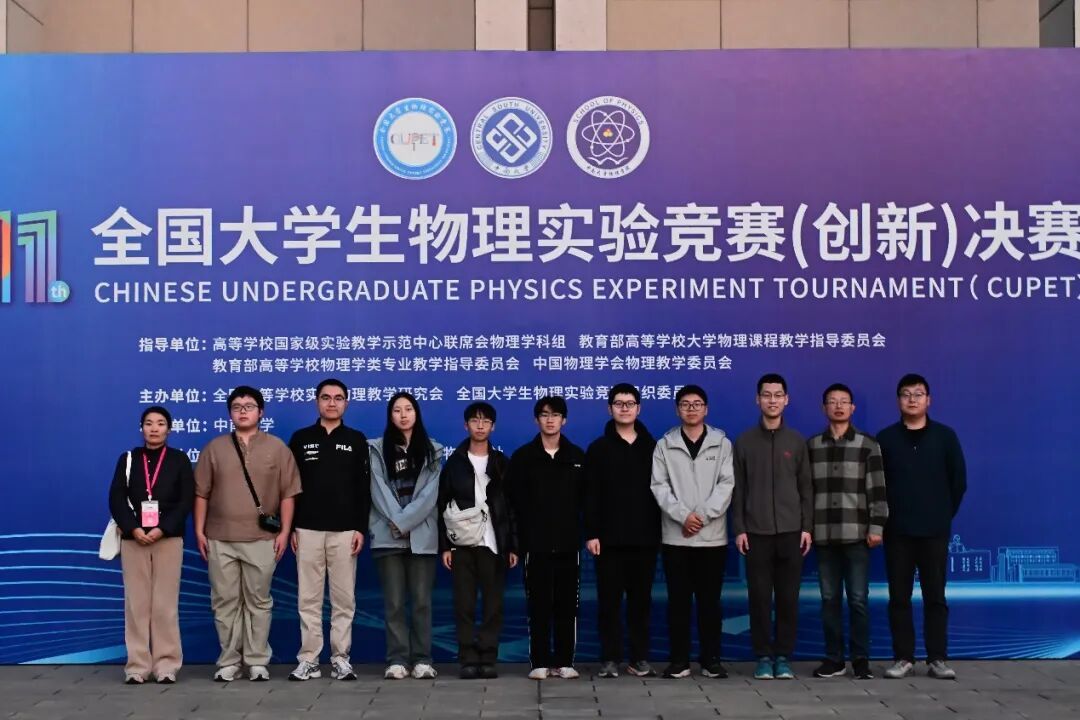
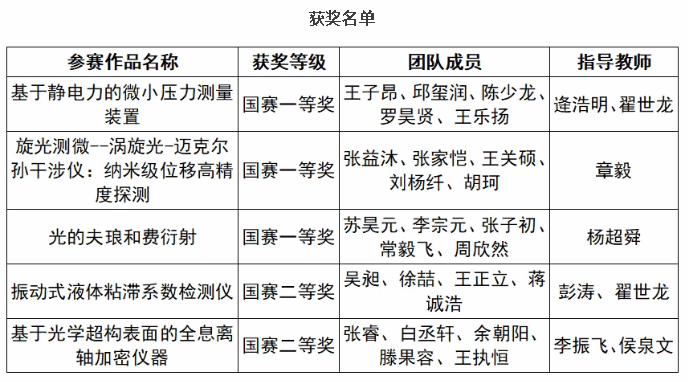
The National College Physics Experiment Competition is a national-level physics discipline experiment event guided by the Teaching Steering Committee for Physics Majors under the Ministry of Education and the Physics Teaching Committee of the Chinese Physical Society. It is organized by the National College Physics Experiment Competition Committee and the National Research Society for Experimental Physics Teaching in Higher Education. This competition is included in the National College Student Competition Rankings and is the only physics-related competition on the list. Since its launch, the competition has garnered widespread attention from universities across the country, with over 750 universities, 3,260 teams, and nearly 20,000 teachers and students participating. After preliminary selections, 750 teams from 331 universities, comprising over 2,000 teachers and students, advanced to the on-site finals. Through poster presentations, instrument demonstrations, and on-site defenses, first and second prizes were awarded.
First Prize Projects
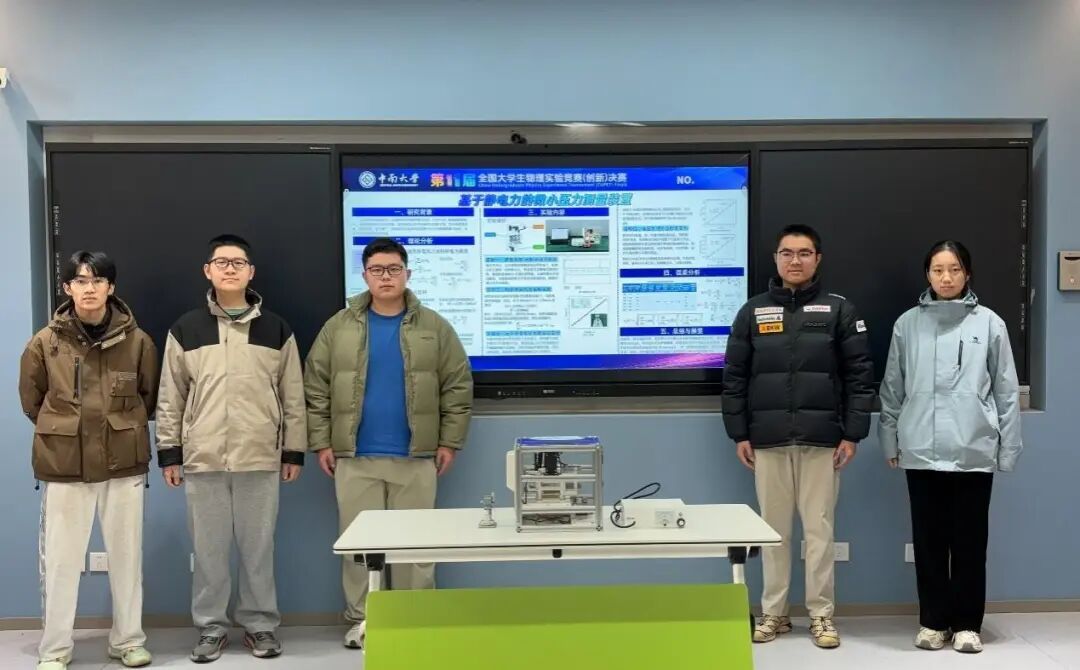
Micro-Pressure Measurement Device Based on Electrostatic Force
This device operates on the principle of the tiny electrostatic force generated when coaxial electrostatic cylinders undergo axial displacement. It consists of three subsystems: the electrostatic cylinder system, the balance system, and the optical system. The five-axis adjustable electrostatic cylinder system ensures the coaxial alignment of the inner and outer cylinders. The highly stable and sensitive balance system responds precisely to minute force values. The optical system amplifies the tiny angular displacement of the balance system and uses a high-precision linear CCD to collect spot position data. This data is processed using time-averaging filtering and peak centroid calculation algorithms. The device ultimately achieves micro-pressure measurement in the range of 0–100 μN with a precision of 0.5 μN.
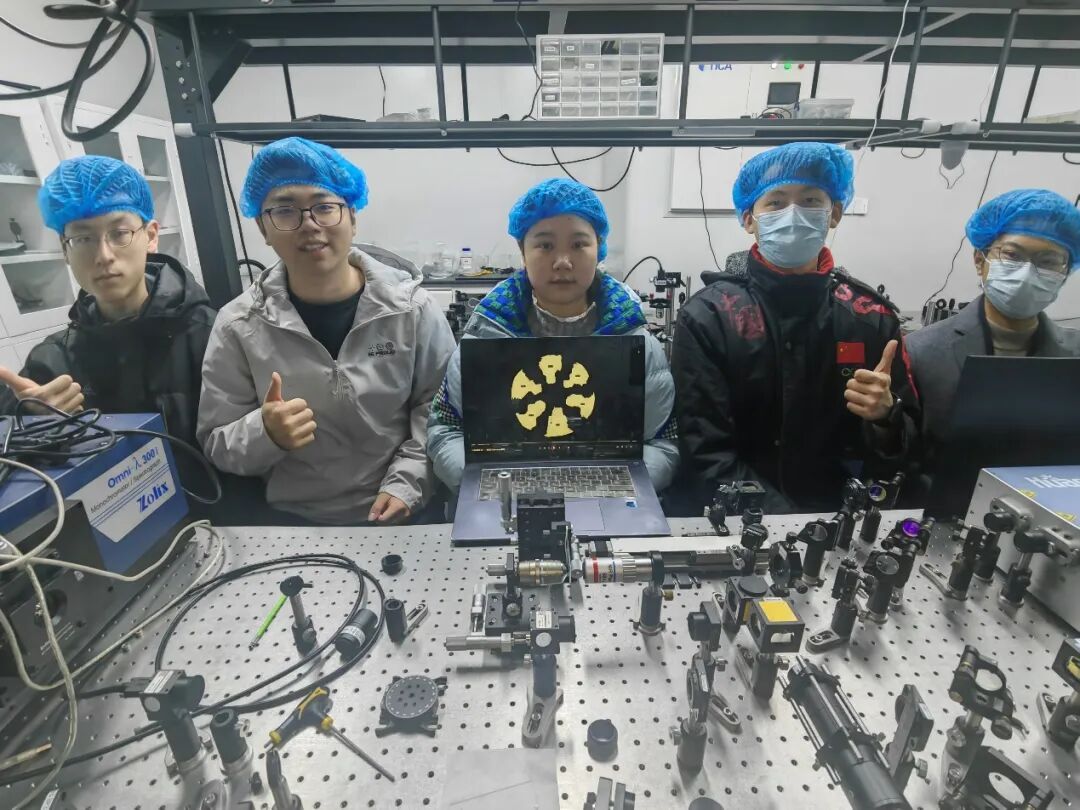
Optical Rotation Micrometry—Vortex Light-Michelson Interferometer: High-Precision Detection of Nanoscale Displacement
This device innovatively integrates vortex light technology into a Michelson interferometer to achieve high-precision measurement of nanoscale displacement. By using a q-plate to generate superimposed conjugate vortex beams with topological charges of ±2 and ±3, a petal-shaped interference pattern is formed, converting displacement into pattern rotation angles. A self-developed geometric algorithm calculates the angular change between the centroid of the petals and the geometric center to deduce displacement. This enables the measurement of minute displacements, real-time vibration recognition, and background noise detection, with a sensitivity of 0.291 °/nm, a precision of 3.1 nm, and an extendable range of up to 2 μm. With a system response time of 33.3 ms, it offers advantages such as non-contact operation, intuitiveness, real-time capability, anti-interference, multi-scale range, and high precision. This provides a low-cost, high-precision solution for fields like precision manufacturing and micro-vibration monitoring.
Fraunhofer Diffraction of Light
This project integrates theoretical analysis, experimental verification, and numerical simulation to systematically study Fraunhofer diffraction phenomena for single slits and various aperture shapes. Based on the Fresnel half-wave zone method and diffraction integral method, the project provides a qualitative explanation of the light intensity distribution for single-slit diffraction and extends it to two-dimensional apertures, analyzing the characteristics and formation mechanisms of diffraction patterns. An optical system was constructed to observe diffraction patterns of different apertures, with experimental results aligning closely with theoretical predictions. Using MATLAB simulations and Manim animation, educational micro-videos were produced. The project innovatively combines multi-aperture comparative experiments, numerical simulations, and animated demonstrations, creating a teaching model that integrates scientific rigor, intuitiveness, and engagement, thereby enhancing the teaching effectiveness and dissemination of Fraunhofer diffraction.

The university places great emphasis on the development of physics discipline competitions. The Academic Affairs Office and the School of Physical Science and Technology have provided strong support in terms of organization and coordination, selection and training, funding, and venue arrangements. In 2022, the Physics Discipline Competition Innovation Practice Base was established. During the competition, the participating teams leveraged the base’s resources, including faculty guidance, experimental equipment, and innovation incubation mechanisms, to solidify theoretical foundations, foster collaborative innovation, and produce high-quality entries. This fully demonstrates the effectiveness of the university’s talent cultivation efforts. Moving forward, the university will continue to deepen teaching research and reform, strengthen the educational approach of "promoting teaching and learning through competitions," enhance students’ experimental and practical skills, and fully leverage its leading and supporting role in strengthening engineering disciplines. This will provide robust support for cultivating "chief engineer-type" talents at the university.
(Text:Zhai Shilong; Audit:Song Kun, Chao Xiaorong)
 Address: Chang'an Campus of Northwest University of Technology, No. 1 Dongxiang Road, Chang'an District, Xi'an
 029-88431652 | Email: phys@nwpu.edu.cn


All rights reserved by School of Physical Science and Technology, Northwestern Polytechnical University
